ISGCT Speech Bangalore, India
Speech made at the 2017 convention for the International Society for Gene & Cell Therapy
[slide 1]
Welcome and Introduction
[slide 2]

My son's name is Courtland Damien Brown. Courtland is very liberal and never missed a chance to vote in local, state, and national elections. As a member if the Chickasaw tribe, [slide 3]

Courtland studied the Chickasaw language. He named his pet pug Chuk Masi - which translates to "pretty lady". He was also well-versed in the Spanish language. While in College, Courtland helped tutor English to Salvadorian refugees. [slide 4]

He also studied at the University of Mayab near Merida, Mexico in the Yucatan peninsula. [slide 5]

For recreation, Courtland enjoyed movies, alternative music, snowboarding and playing hockey on in-line skates.
[slide 6]

On 14 December 1998, Courtland suffered multiple broken bones, internal injuries, and a closed head injury during an automobile crash. Courtland was a passenger in a small car that was t-boned by a large SUV - which was going 70 mph (112 kph) in a 55 mph (88 kph) speed zone. Courtland spent five months in a trauma center in San Antonio, TX. Courtland is a strong-willed child. I think this characteristic kept him alive during his stay in the trauma center. Thirteen months after the crash, Courtland received the first of several stem cell treatments.
During the hospitalization, Courtland had a small portion of the right frontal lobe removed, a large hematoma on the left frontal lobe removed, and a lumbar-peritoneal shunt placed to relieve intracranial pressure. Upon his release from the hospital, Courtland was described as awake but non-responsive. The first seizure occurred in August 1999. The seizure lasted 1.5 minutes; involving head and facial movement with spastic motion of both arms. [slide 7]

Three months later (one year after the crash), we took Courtland to the Neubauer Hyperbaric Oxygen Medical Center in Ft Lauderdale, FL for hyperbaric oxygen therapy (HBOT).
[slide 8]
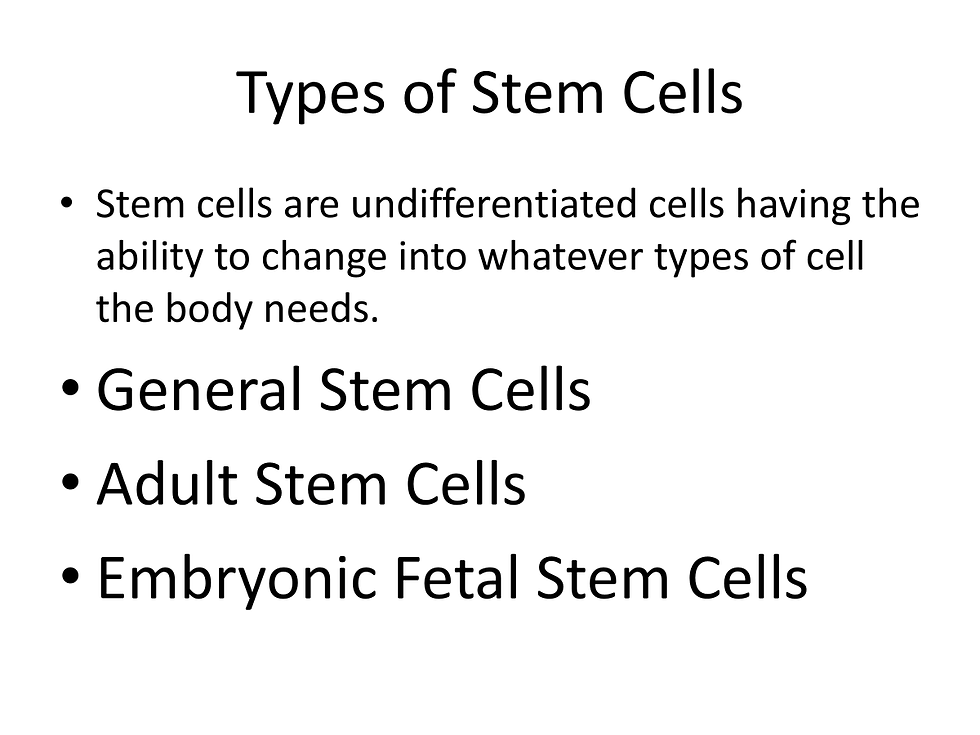
Stem cells are undifferentiated cells having the ability to change into whatever types of cell the body needs. Scientists first identified stem cells in 1981. By 1998, scientists developed a method to cultivate stem cells in a laboratory situation. There are three categories of stem cells: General Stem Cells, Adult Stem Cells and Embryonic Fetal Stem Cells.
[slide 9]

There are many sources of stem cells:
1. Bone marrow
2. Fat cells
3. Cells from umbilical cord/amniotic fluid
4. Adult blood
5. Olfactory nerve endings
6. Skin cells
7. Human embryo
(Judie Brown, Web 2 March 2012)
[slide 10]

Courtland was still unresponsive in November and December of 1999. We started a physical therapy program with a private therapist in Ft Lauderdale. The program involved getting Courtland into different positions to stimulate the brain, activate blood flow and strengthen the muscles. One activity had Courtland lay across a large ball. We would move the ball to create the sense of motion and to stimulate the vestibular system. Because he did not have control of his neck muscles, his head rested on the ball. The preferred head position was a hard-fix to the left.
[slide 11]

Courtland experienced a SPECT (Single-Photon Emission Computed Tomography) scan on 13 January 2000 after 40 HBO treatments. According to Dr Neubauer's Nuclear Medicine Laboratory Worksheet; "There appeared to be minimal positive changes at this time. There were positive changes in the area of both occipital lobes. The defects in the frontal lobes remained. There was better symmetry on the coronals." Earlier, Dr Neubauer introduced us to a doctor who offered fetal stem cell therapy. Courtland received the first set of stem cells on 14 January 2000. We did not blithely enter into this medical procedure. We (my wife and I) interviewed the doctor and did some research.
[slide 12]

The doctor had investigated stem cell research conducted in Eastern Europe. These scientists provided their research methodology, medical records and patients treated by their process. The doctors provided support showing stem cells lacked antigenicity; therefore, there was NO risk of graft-versus-host disease. The doctor's current program for developing stem cells, included tests that ensured the safety and purity of the material. Tests established that the materials are free of viral, bacterial and fungal infections. The laboratory uses a PCR DNA test to screen for HIV infections. The sophisticated tests reveal HIV material from a week-old infection. The laboratory also screens for abnormal chromosomal arrangements.
[slide 13]

Courtland's stem cell treatment involved injecting fetal stem cell material into the blood stream. Then, the doctor injected a series of neuronal stem cells into the abdominal muscles. After the stem cell treatment, Courtland continued to receive HBO therapy.
[slide 14]

After 182 hyperbaric oxygen treatments and 75 days post stem cell injections (28 March 2000), Dr Neubauer ordered a second SPECT scan. The NML worksheet states: "a comparison of the SPECT scans showed dramatic changes. There was marked filling in, especially in the occipital lobes. The frontal lobes have increased profusion, the major deficits on the left filled in by at least 50 percent on the 3D surface reconstruction."
[slide 15]
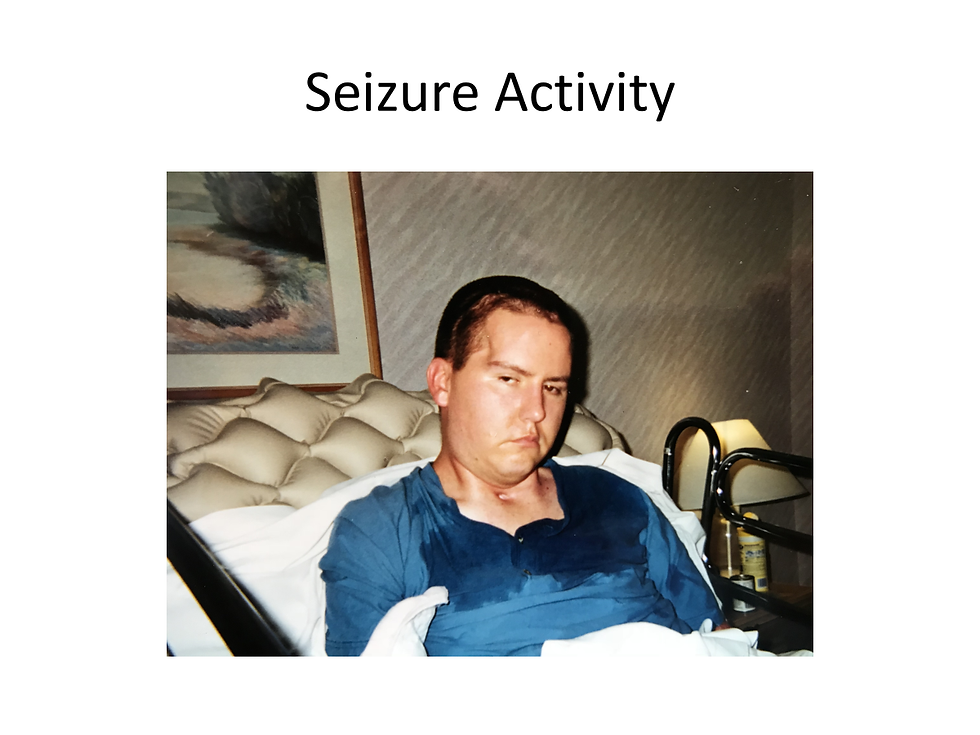
Courtland continued to have periodic seizures. Started as one twice a year, then one every three months, finally one a month. Some of the seizures were very tiring for Courtland, after others he quickly returned to normal.
[slide 16]

There were other observed improvements. In February 2000, Courtland began pulling liquids through a straw. He was not able to swallow the liquids freely. To get him to swallow the liquids, I would place solid food (pieces of crackers, cookies or popcorn) in his mouth. Courtland would chew the solid food and nicely swallow the mixture. He suffered NO aspiration during the style of eating.
During PT sessions, Courtland supported his head while draped over the large gym ball. The physical therapists got Courtland to stand under a ladder-like structure. They were able to have him grab the rungs of the ladder while standing upright. At first, it required four people to help Courtland walk the length of the ladder: two people held him upright, one person moved his legs, and one person moved his arms.
[slide 17]

We worked with Courtland at home. He worked out on the Quadricizer for two hours each day. Every afternoon, he occupied the standing frame for an additional two hours. The standing frame has a vibrating platform that sends pressure waves through his body - trying to strengthen the bones. Once a year, Courtland received stem cell therapy.
[slide 18]

After the third treatment, Courtland was able to use a drinking cup appropriately. He also used a spoon to put food in his mouth. We put the food in the spoon and Courtland would eat the food from the spoon.
[slide 19]

During a visit to a neuroptomatrist, Courtland made his first response to humor. His mother made a comment about cleaning his nose (something about boogers) and Courtland smiled. His awareness of humor continued to increase. Today, he responds to verbal and sight jokes presented in movies and on television.
[slide 20]

Currently, Courtland is able to make decisions. We ask him questions and he responds. We always support his decisions. At night we ask him "Do you want to listen to Sherlock Holmes or to a cowboy story? Show me one finger if you want to listen to Sherlock Holmes. Show me two fingers if you want to listen to a cowboy story. We use this procedure for as many situations as possible: go to bed or watch TV; taste fruit or pizza; wear a red shirt or a blue shirt. At one point, Courtland had had a very tiring day. He was in the wheelchair near his bed. I had my back to him and was talking while I fixed his pillows. I said that I knew he was tired and that I was going to ask him if he wanted to take a bath first or just go to bed. When I turned around, Courtland was showing me 2 fingers! That was fantastic! Because of his cognition, we are very careful about what we discuss in Courtland's presence. We want him to have as much positive reinforcement as possible.
[slide 21]

The stem cells have improved Courtland's health and mental functions. In 19 years, he has had one bout of pneumonia; one severe infection; and one pressure sore.
[slide 22]
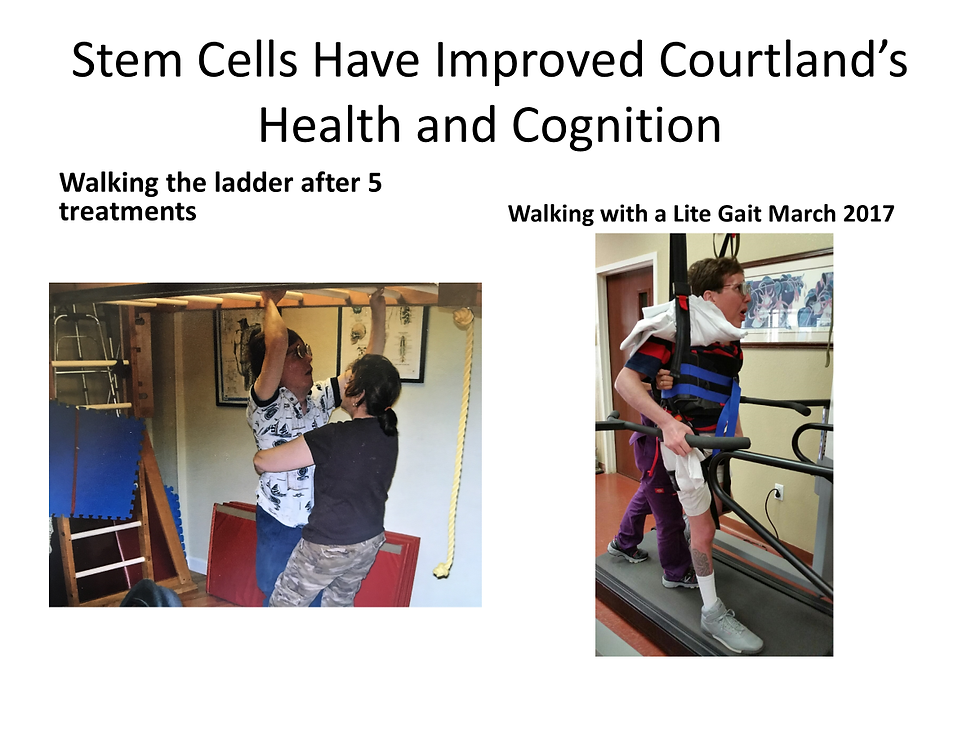
His positive response to physical therapy continues to improve.
[slide 23]

Each day we see small improvements in Courtland's strength, cognitive abilities and general health.
[slide 24]

General Stem Cells have a good history in the treatment of childhood leukemia. In a few cases, the General Stem Cell treatment changes the phenotype of the patient. One six-year-old boy was originally blood Type A. After the stem cell treatment, he was free of the leukemia and had blood Type O. We need to continue to use General Stem Cells to treat the appropriate disorders and to investigate their use in other treatments.
[slide 25]

Adult Stem Cells have been used for many years to treat leukemia, immune system disorders, cancers, autoimmune disease and 70 other diseases successfully. Adult Stem Cell treatment is good because the procedure uses the person's own stem cells. The cells are incubated to a sufficient number and returned to the host. Adult Stem Cells are not as viable as Embryonic Stem Cells. Therefore, they should be used as soon as the disease is identified. Early detection and treatment (cancer) is important so that the host's body is healthy enough to help the cells overcome the disease.
[slide 26]

Embryonic Stem Cells are more successful than Adult Stem Cells. A Belgian research paper states: "Cells derived from fetal tissues are higher in number, expansion potential and differentiation abilities compared to stem cells from adult tissues." There are many antidotal success stories of embryonic stem cells' ability to overcome symptoms of cerebral palsy, epilepsy, and brain injury. Embryonic Stem Cell treatment is not a magic bullet. A few disorders may be treated with one session of stem cell therapy. Neurological trauma is not one of these. It requires several therapy sessions to reach modest results when treating brain injury. Courtland is much improved from his 2000 status, but in no way is he "cured" of his closed head injury. We need more research to validate and standardize stem cell treatment for hard-to-treat diseases/injuries.
[slide 27]

As parents investigating stem cell treatment for their child, there are dangers and things to avoid related to stem cell therapy.
1. Embryonic stem cells must be healthy and free of viruses and abnormal chromosome structures.
2. Laboratory strains of embryonic stem cells (especially from US laboratories) must be avoided for human use because: "The strains fail to support the full range of stem cell research since they lack genetic diversity, are beginning to accrue genetic mutations, and are grown on mouse feeder layers which have introduced animal viruses." Nyum
3. Doctors using stem cell therapy must be honorable. One such doctor working from a laboratory in Mexico requires patients to bring thousands of dollars in CASH across the border and into the Mexican interior. Traveling with large amounts of CASH is never a sound idea.
4. Stem cell therapy must be based on human stem cells. This may seem obvious, but a clinic in Canada makes a great deal of money treating patients with frozen sheep stem cells. I know two families who took their child (one with a closed head injury, one with cerebral palsy) to this clinic for treatment. Neither treatment was successful.
A lady in my hometown of Boerne, TX suffered from cancer. Even though we tried to convince her to try a different procedure, she was adamant about going to Mexico to be treated with sheep stem cells. This endeavor cost a great deal of money, and I am convinced it cost her her life.
I also had an American Medical Association professional try to convince me to treat Courtland with duck stem cells. He claimed that "duck stem cells are the closest to human stem cells we can get." That is ridiculous! Most high school biology students know that a chimpanzee matches 95% of our DNA - even that is not close enough for use in human therapy.
[slide 28]

From my own experience, Embryonic Stem Cell therapy has greatly improved the health and cognition of Courtland.
[slide 29]

We need more research into the best ways to use stem-cell therapy as a means to relieve people of debilitating injuries, devastating diseases, and unbearable pain. Quoting Nancy O'Brien, "The issue of stem cell research does not force us to choose between science and ethics, much less between science and religion. It presents a choice as to how our society will pursue scientific and medical progress."
Comments